Now that I have been given the task of personally crafting a set of ethical considerations and guidelines for myself as a journalist, I believe that my foundation shall be built on the notions of balance. Balance by definition means an equal distribution of weight or amount; mental steadiness. It seems to me that the whole existence of a journalist is a constant balancing act: balancing personal biases between those of the audience you write for and the organization you write for; balancing the multiplicity of perspectives and narratives that are present in every story; balancing the need to obtain and illuminate ‘important’ information (by personal standards) with the public’s interest/need to know that information, all the while considering the negative outcomes that are inherent in publishing such information; etc. With these considerations in mind the notion of objectivity becomes more tangible: as a journalist, if I persistently conduct myself in a way that utilizes these notions of balance the resulting work I produce will never stray into my own or other biases, nor never position one side of the story’s facts/perspectives over another. Though balance in itself provides enough of a guiding principle to conduct oneself ethically in journalism, I find it is useful to further root it within the philosophical paradigms of Aristotle’s Golden Mean and the Buddhist Middle Path. Both the Golden Mean and the Middle Path extol a need to dynamically adjust to any situation by using moderation and balancing oneself in between the extremes of self-indulgence and self-mortification. When writing a piece on a specific person or group, the application of the Golden Mean and the Middle Path directs the story in the most objective and fair ways: a journalist should neither intentionally lampoon nor lavish with admiration/praise a subject, they should always allow for these varied perspectives to exist in context with each other and thus let the reader draw their own conclusions. Other than not fabricating facts/pieces of a story, conducting journalism in illegal manners, and intentionally biasing your work, I don’t believe there can be any hard-and-fast rules in journalism – as each case presents a unique set of circumstances and characters. In this light Kant’s Categorical Imperative is of little relevance. I find the ethical calculator that is the Potter Box an incredibly useful resource: a journalist should take time to consider the situation they’re trying to portray (what’s most important and why), they should know already what values they have as a journalist (i.e. not suppressing public information), what guiding ethical principles they work by (in this case, the Golden Mean and the Middle Path), and what loyalties they wish to serve (i.e. the general readership, the subjects involved in the story, etc.). Though I don’t think that a journalist should sit down and carefully run every tidbit through the Potter Box, I do think that the framework can be applied and utilized at crucial points in creating a story – before the piece has begun, in the midst of investigation, while writing and a final assessment after having written the piece. In this manner, a journalist who always makes these considerations can step back and comparatively analyze their works to determine whether or not they have maintained a consistent ideal of objectivity, and most importantly, balance.
Wednesday, December 14, 2011

Wednesday, November 9, 2011
The 5 Ballsiest Acts of Undercover Journalism Ever | Cracked.com
Wednesday, November 2, 2011
Canadian Satirist's Fictional Quote About OWS Taken Seriously By Some In GOP
From NY Times
By: Malia Wollan & Robert Mackey
Mark Schatzker, a Canadian satirist, told The Lede on Wednesday that it was "a huge surprise" to him to learn that opponents of the Occupy Wall Street movement in the United States, including Gov. Rick Perry of Texas, have been using this quote, from a 38-year-old protester named Jeremy puzzled by the habits of bankers on Bay Street, in Toronto's financial district, as evidence that that the protesters are lazy:
"It's weird protesting on Bay Street. You get there at 9 a.m. and the rich bankers who you want to hurl insults at and change their worldview have been at work for two hours already. And then when it's time to go, they're still there. I guess that's why they call them the one per cent. I mean, who wants to work those kinds of hours? That's the power of greed." - Jeremy, 38
Mr. Schatzker was surprised because Jeremy is a fictional character he invented recently for his weekly humor column published in Toronto's Globe and Mail newspaper.
As the Web site Mediate reported this week, opponents of the protest movement were apparently so pleased to read the quote Mr. Schatzker attributed to Jeremy — a 38-year-old protester puzzled by the habits of bankers on Bay Street, in Toronto's financial district — that they failed to notice that the column was clearly labelled "Satire" at the very top before copying the text and sharing it by on Facebook, in e-mails, on blogs and evenin outraged YouTube videos.
The fake quote was so widely cited that it even ended up being repeated on Tuesday by Gov. Rick Perry of Texas, at a campaign event.
Mr. Perry said that the quote had been sent to him by his son, who reportedlyworked in the financial industry until recently.
Speaking to The Lede by telephone on Wednesday, Jeremy's creator, Mr. Schatzker, said that the fictional quote had also been sent by e-mail to his brother, who also works in the financial industry, by someone who thought it was real. The satirist also said that it had never occurred to him that anyone might mistake his attempt to poke fun at the Occupy movement, by inventing a series of satirical quotes from protesters, for a real news report on Occupy Toronto. He writes, he said, for an audience of readers in Toronto who are familiar with his work.
Mr. Schatzker also insisted that he had not written the column as part of "a conspiracy to punk the right," as some people have suggested since it was reported that his satire had been mistaken for journalism. He pointed out that several of the quotes in the column were so ridiculous that it was hard to see how anyone could take the text seriously. He pointed, in particular, to the very first quote, which mocked the idea of protests in a country that already has generous social-welfare benefits, through the words of another fictional protester, identified as Tracy, 20, who said: "Looking back, I can't believe what we achieved in a few incredible days: government-funded health care, a well-regulated banking system, and a cap on corporate political donations. Our work is done."
The cross-border misunderstanding between a Canadian author and some of his American readers is particularly interesting given that it was a Canadian media organization, the anticorporate magazine Adbusters, which came up with the idea for the entire Occupy Wall Street movement.
Friday, September 23, 2011
L.A. Times & New York Times' Ethical Guidelines For Employees
Wednesday, September 14, 2011
US Media Downplaying Radical Christian Theology Increasingly Prominent In GOP
| Two questions to consider before and after reading this article:
- Is it ethical for the media to scrutinize(?) someone based upon their religious beliefs if that person is running for office/public position of authority? How can a journalist objectively represent the beliefs of a particular religion or religious sect? |
The US media has been downplaying a radical Christian theology that is increasingly influential in the Republican Party. Paul Rosenberg Last Modified: 06 Sep 2011 13:35 | |
With Representative Michele Bachmann's victory in the Ames, Iowa straw poll, and Texas Governor Rick Perry's triumphal entrance into the GOP presidential primary, there's been a sudden spike of attention drawn to the extremist religious beliefs both candidates have been associated with - up to and including their belief in Christian dominionism.(In the Texas Observer, the New Yorker, and the Daily Beast, for example.) The responses of denial from both the religious right itself and from the centrist Beltway press have been so incongruous as to be laughable - if only the subject matter weren't so deadly serious. Those responses need to be answered, but more importantly, we need to have the serious discussion they want to prevent. For example, in an August 18 post, originally entitled, “Beware False Prophets who Fear Evangelicals”, Washington Post religion blogger Lisa Miller cited the three stories I just mentioned, and admitted, “The stories raise real concerns about the world views of two prospective Republican nominees”, then immediately reversed direction: “But their echo-chamber effect reignites old anxieties among liberals about evangelical Christians. Some on the left seem suspicious that a firm belief in Jesus equals a desire to take over the world.” Of course, she cited no examples to bolster this narrative-flipping claim. More importantly, she wrote not one more word about the real concerns she had just admitted. Dominionism is not a myth "What In Heaven's Name Is A Dominionist?" Pat Robertson asked on his 700 Club TV show, one of several religious right figures to recently pretend there was nothing to the notion. Funny he should ask. In a 1984 speech in Dallas, Texas, he said:
Furthermore, C Peter Wagner, the intellectual godfather of the New Apostolic Reformation (NAR), actually wrote a book called Dominion! in 2008. Chapter Three was entitled “Dominion Theology”. When pressed, Peter likes to pretend that his ideas are just garden-variety Christianity, based on Genesis 1:26, in which, before the fall, God gives Adam and Eve dominion over the natural world - a far cry from dominion over other people, who did not even exist at the time, as evangelical critics of this dominionist argument have repeatedly pointed out. Dominionism is not new Dominionist ideas have circulated throughout the religious right for decades prior to Robertson's 1984 speech. A primary source was the small but influential sect known as Christian Reconstructionism, founded by R J Rushdoony in the 1960s, which advocates replacing American law with Old Testament codes. Centrists like Miller make the mistake of thinking that the small size of Rushdoony's core of true believers is the full extent of his influence. But this is utterly mistaken. As Michelle Goldberg wrote in Daily Beast, “Rushdoony pioneered the Christian homeschooling movement, as well as the revisionist history, ubiquitous on the religious right, that paints the US as a Christian nation founded on biblical principles. He consistently defended Southern slavery and contrasted it with the greater evils of socialism.” A second source traces back to the roots of the Latter Rain movement of the late 1940s, long rejected by orthodox evangelicals because they contradicted scripture and denied primary agency to God - which is why they insist that Christians must actively establish church dominance over all of society, because God can't do it alone. The Latter Rain was denounced by the Assemblies of God - the largest American Pentecostal church - in 1949, not solely for dominionist ideology, but for a variety of related beliefs and practices. When similar teachings and practices re-emerged in the guise of the New Apostolic Reformation 50 years later, the Assemblies of God denounced them again in 2000. This time, however, many Assemblies of God congregations have increasingly accepted the NAR influence. Sarah Palin's long-time church in Wasilla is one such congregation. The most clear-cut example of NAR dominionism is the so-called “Seven Mountains Mandate”, which holds that dominionist Christians should control the whole world by infiltrating and dominating the “Seven Mountains” of culture: (1) Business; (2) Government; (3) Media; (4) Arts and Entertainment; (5) Education; (6) Family; and (7) Religion. Dominionism is not a left-wing fantasy A number of authors made charges similar to or derived from Joe Carter, web editor of First Things, who wrote: "The term ["dominionism"] was coined in the 1980s by [sociologist Sara] Diamond and is never used outside liberal blogs and websites. No reputable scholars use the term for it is a meaningless neologism that Diamond concocted for her dissertation." However, at the same time Diamond was working on her dissertation - published as the book Spiritual Warfare in 1989 - evangelical writer/researcher Albert James Dager was taking similarly critical aim, though from a different direction. In 1986 and '87, he published a multi-issue essay “Kingdom Theology” in the publication Media Spotlight. In that text he also used the terms "Kingdom Now" or "Dominion" Theology. In 1990, Dager, too, published a book,Vengeance Is Ours: The Church in Dominion. While his main focus was doctrinal error and non-Christian practices and influences, Dager's work traced dominionism back to the 1940s and even earlier. Many more have followed in his footsteps since then. If you Google the words “dominionism” and “heresy”, you'll get more than half a million hits. It should be obvious to anyone that conventional conservative Christians have big problems with dominionism - if only the United States' establishment media could figure out how to use Google. Dominionism is not an imprecise catch-all term Despite lingering definitional differences that are common with relatively new terminology, those who study dominionism and related phenomenon in a political framework have an increasingly common and precise terminology that most writers and researchers share. Researcher Chip Berlet of Political Research Associates provided a very useful guide, “The Christian Right, Dominionism, and Theocracy”, which addresses issues of terminology from several different perspectives - for example, between “generic dominionism” and specific dominion theologies. Berlet also draws a distinction between “hard” and “soft” dominionists. “Soft Dominionists are Christian nationalists,” he writes. “They believe that Biblically-defined immorality and sin breed chaos and anarchy. They fear that America's greatness as God's chosen land has been undermined by liberal secular humanists, feminists, and homosexuals ... Their vision has elements of theocracy, but they stop short of calling for supplanting the Constitution and Bill of Rights.” Hard Dominionists add something more to the mix: “They want the United States to be a Christian theocracy. For them the Constitution and Bill of Rights are merely addendums to Old Testament Biblical law.” Rushdoony's Christian Reconstructionists clearly fall into the hard dominionist camp. But the NAR seems to straddle the soft/hard division. On the one hand, they clearly do claim that conservative Christians are ordained to run the world, not just US society. Thus, the Seven Mountains Mandate. On the other hand, Wagner and others have argued that the Seven Mountains is compatible with democracy. The state of Hawaii shows how: Early in the 2010 election cycle, both the Republican and the Democratic frontrunners for governor were associated with the NAR. That changed when long-time Congressman Neil Abercrombie joined the race on the Democratic side, and eventually won the race handily. But for a while, the NAR came tantalisingly close to realising their dream, at least in one state - not just to win power, but to occupy all the possible paths to power. What's more, in a recent article at Talk2Action, Rachel Tabachnick draws attention to another hedge on Wagner's part, quoting from Dominion! In a section entitled “Majority Rules”: "If a majority feels that heterosexual marriage is the best choice for a happy and prosperous society, those in the minority should agree to conform - not because they live in a theocracy, but because they live in a democracy. The most basic principle of democracy is that the majority, not the minority, rules and sets the ultimate norms for society." This, of course, is utterly false in a liberal democracy, such as the United States. Liberal democracies combine majority rule as a general governing principle with a framework of rights protecting individuals in political minorities from persecution, political repression, and the like. The fact that Wagner so utterly misunderstands the foundations of American democracy shows just how dangerous such “soft” dominionism can be. This same lesson can be drawn from Uganda as well, where several different strains of dominionist theology have combined to bring that nation to the verge of passing a law that will make homosexuality punishable by death. Such is the nature of illiberal dominionist “democracy”. Europe's bloody theocratic wars This brings us, finally, to the serious discussions that dominionists and their enablers, like Miller, are trying to prevent. The first of those is about the very nature of American democracy. For nearly 200 years, Europe was torn apart by a series of religious wars and their bloody aftermath - the major reason that the United States was founded as a secular republic. We're potentially on the verge of forgetting all that history and suffering through it again, just as we're now suffering through forgetting the lessons of the Great Depression. Those centuries of war began with the German Peasants' War of 1524-26, in which more than 100,000 died; continued through the 1648 Treaty of Westphalia, which ended the Thirty Years War on the European continent; and lasted until the end of the War of the Spanish Succession (1701–1714). This was the bloody European history of religious intolerance and strife that many, if not most, American colonialists were fleeing from when they came to the New World. It was also this bloody history that gave rise to the development of classical liberalism, affirming the individual right to religious liberty and replacing the top-down theocratic justification of the state with Locke's concept of the bottom-up social contract, based on the consent of the governed. The ideas that Locke perfected took generations to develop. Religious tolerance, for example, began as simply a matter of pragmatism: unless people stopped killing each other for differing religious beliefs, war in Europe would never end. But gradually, the idea took hold that tolerance was a positive good, and key to this new perspective was the recognition that torturing someone to change their beliefs could not produce the desired result of a genuine heartfelt conversion. Thus, the moral rejection of torture - another feature of classical liberalism - had its roots in the evolution of the idea of religious liberty. The idea of utterly forgetting the prolonged bloody history that the United States was born out of is no laughing matter. The same could be said of the myth that the United States was founded as a Christian nation, with laws based on the Bible. Of course most Americans were Christians at the time, but the leading intellects were decidedly less so, much more influenced by Enlightenment thought. There were many, such as Jefferson, who were better described as Deists, who believed that God had created a rational universe, but did not intervene supernaturally thereafter. They deliberately used terms like "the Creator" and "Nature's God" to affirm their distinctive, non-Christian view. Moreover, God was not mentioned at all in the Constitution, and religion was only mentioned to exclude its influence, stating that no religious test should be required for office. Finally, US law was based on British common law, not the Bible. The Supreme Court itself is a common law court, following common law precedents and practices. And British common law traces back to Roman law, which first came to England centuries before Rome adopted the Christian religion. Of course the intolerant religious right wants us to forget this. How else could they ever gain power, except through massive forgetting of who and what the United States really is? Not to mention who and what they are: the most fundamental enemies of the United States, who would, if they could, return us to the centuries of blood before the US was born, the nightmare out of which the United States awakened. Theocratic thinking threatens the US today There are very immediate consequences that flow from the theocratic mindset. You'll note, for example, that the "Seven Mountains" of culture do not include science. That's not because dominionists intend to leave science alone, but rather because they see no need to dominate what they can simply cut off, ignore and deny. If science tells them that homosexuality is an inborn trait, why fight that in the realm of science when politics, the media, religion and education offer much, much better places to fight? After all, who says that education has to be based on facts? The same holds true for evolution and global warming as well, not to mention the workings of the economy. One rightwing denier of dominionist influence, Washington Post columnist Michael Gerson, even framed his attack as “An unholy war on the Tea Party, while another denier complained that instead of describing the Tea Party as a movement united around concern about big government, many journalists seem to be trying to redefine the colour red by overlaying religious intent and purpose on the movement. Yet the dominionist connection to the Tea Party goes far beyond just the two candidacies of Michele Bachmann and Rick Perry. Ron Paul, whose extreme anti-government positions helped to fuel the emergence of the Tea Party, has much deeper dominionist connections than either of the two new darlings. During his first term in Congress, one of his aides was Gary North, Rushdoony's son-in-law, and a leading Reconstructionist in his own right, who has written extensively on so-called "Biblical Capitalism", an ideology profoundly at odds with traditional Biblical-based teachings on economic justice. While libertarians once traced their descent from John Locke, and more recently from the deeply anti-Christian Ayn Rand, Reconstructionism represents an increasingly important foundation for their views. A recently released sociology study, "Cultures of the Tea Party", found that Tea Party supporters are characterised by four dispositions: "authoritarianism, ontological insecurity, libertarianism, and nativism". Since traditional libertarianism was purportedly the opposite of authoritarianism, this highlights how radically libertarianism has changed - a conclusion that's echoed by the 2011 Pew Reaserch Political Typology Poll, which found that religious and economic conservatives had completely merged into one single group since 2006 and all previous polling. What this means in the long run is far from clear. But it strongly suggests a solidfying outlook with deep Reconstructionist sympathies that actually looks at government failure to deal with major issues, such as restoring the economy, as a positive good. If faith in American institutions collapses entirely, then who wouldn't give Biblical law a shot? The more loudly such people proclaim themselves patriots, the more loudly they cheer for US collapse.It's not just Obama they want to fail. It's the very idea of America. Paul Rosenberg is the Senior Editor of Random Lengths News, a bi-weekly alternative community newsletter. You can follow Paul on twitter @PaulHRosenberg The views expressed in this article are the author's own and do not necessarily represent Al Jazeera's editorial policy. | |
Source: Al Jazeera | |
Wednesday, September 7, 2011
Iran newspaper closed down amid row over Mahmoud Ahmadinejad satire

Printing sponsored by:

Iran newspaper closed down amid row over Mahmoud Ahmadinejad satire
Shahrvand-e-Emrooz shut down after mocking president's relationship with 'wise man' Esfandiar Rahim Mashaei

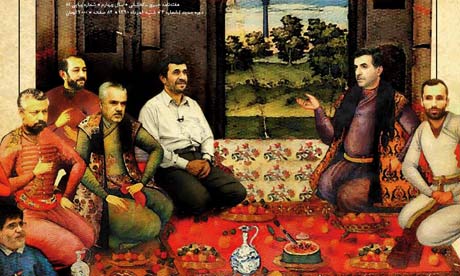
The picture looks like a 16th-century Persian miniature. The wise man on the right is lecturing his companions who kneel dutifully in front of him, listening to his sermon.
But something is not quite right. On second look, it becomes clear that all the characters are in fact recognisable to modern-day Iranians. Indeed, the wise man is none other than Mahmoud Ahmadinejad's confidant, Esfandiar Rahim Mashaei. And in an obvious satire of the country's political leaders, it is Mashaei who counts the president among his obedient followers – not the other way round.
The image appeared on the front page of an Iranian magazine, Shahrvand-e-Emrooz, a month ago. But now it seems the Iranian regime has taken offence, and it is widely believed the picture was the reason behind the enforced closure of the magazine on Monday.
Shahrvand-e-Emrooz was previously shut down, along with several other titles, after the unrest that followed the 2009 elections, but resumed publication recently. Another publication, Roozegar, was also closed on Monday.
The picture highlights the concerns among Iranian conservatives over Mashaei's growing political influence. Supporters of the supreme leader, Ayatollah Ali Khamenei, believe that Mashaei, whose daughter is married to the president's son, is attempting to undermine clerical power in Iran.
Opponents of Mashaei, who favours cultural openness, say he has the president under his "spell" and have accused his team of anything from corruption to sorcery. Several of Mashaei's close allies and some senior aides to the president have been arrested in recent months.
Ahmadinejad's unwavering support for Mashaei has infuriated conservatives and has even cost him the support of Khamenei. In the past six months, a power struggle has developed between Ahmadinejad and Khamenei, which is widely believed to have stemmed from Mashaei's influence.
Analysts believe Ahmadinejad had been grooming Mashaei to succeed him in the next presidential elections, due in two years, but that has now become unlikely. Khamanei is also believed to have chosen to get along with Ahmadinejad rather than orchestrate a feud over Mashaei in an effort to avoid unrest during the elections.
Iran's opposition believes that by focusing on Mashaei and his relatively liberal views, Ahmadinejad is trying to find a way to attract votes and preserve his dwindling power. Analysts say Ahmadinejad and his team are casting their eyes on the period after Khamenei's death.
Tehran's regime has given more space to opposition newspapers in recent weeks in a move to appease them in the runup to parliamentary elections. But it would appear that Shahrvand-e-Emrooz and Roozegar have gone too far in pushing the limits in criticising the government.
In the picture, Mashaei who appears to be in a Safavid dynasty-era costume, is sitting close to Hamid Baghaei, Ahmadinejad's executive deputy, who is shown as a handsome male companion. Iranian bloggers have also joked about Ahmadinejad's relationship with Mashaei, which is often described as affectionate.
Roozegar is believed to have been closed for publishing an interview with an Iranian politician analyst, Morad Saghafi, who referred to the 2009 post-election unrest.
Reporters Without Borders on Tuesday condemned the closure of the publications and the ongoing imprisonment of Iranian journalists and bloggers. "Despite some conciliatory gestures, the Iranian authorities continue to crack down on the media and journalists, closing the weekly Shahrvand e-Emrooz and the daily Roozegar yesterday," it said.
Iran remains one of the world's worst jailers of journalists, according to the Committee to Protect Journalists, which campaigns for press freedom.